How to Choose Piston vs Gear Pump Filling Machines in 2026?

Time:2026-10-04 Author:Liam
0%

In 2026, filling equipment buyers face a practical choice between piston and gear pump machines. Both technologies can deliver accurate, repeatable filling. Their performance changes with product viscosity, temperature, container size, and production speed. How to choose between piston and gear pump filling machines depends on the material, not marketing language.

Piston fillers often suit thick creams, sauces, pastes, and products containing small particles. A controlled stroke measures each dose, while operators can adjust volume mechanically or through a digital interface. Gear pump systems provide steady, continuous flow for oils, lotions, syrups, and other uniform liquids. They can support precise metering, fast changeovers, and automated production lines. However, pump wear may affect accuracy when abrasive materials enter the system.

Real plants are messier than brochures. Product temperature can shift during a long production run. A warm lotion may flow easily at noon but become thicker during a cool morning startup. Cleaning requirements also matter, especially for food, cosmetic, and pharmaceutical applications. Operators should inspect wetted materials, seal design, calibration records, and available technical support before purchasing.

Small details matter.

This guide compares filling accuracy, maintenance, sanitation, operating cost, and scalability. It also examines where each machine can disappoint. A piston filler may be reliable but slower during frequent volume changes. A gear pump may offer speed but require closer monitoring of viscosity and wear. The best decision comes from measured trials, product samples, and honest production data. Assumptions should be tested before approval.
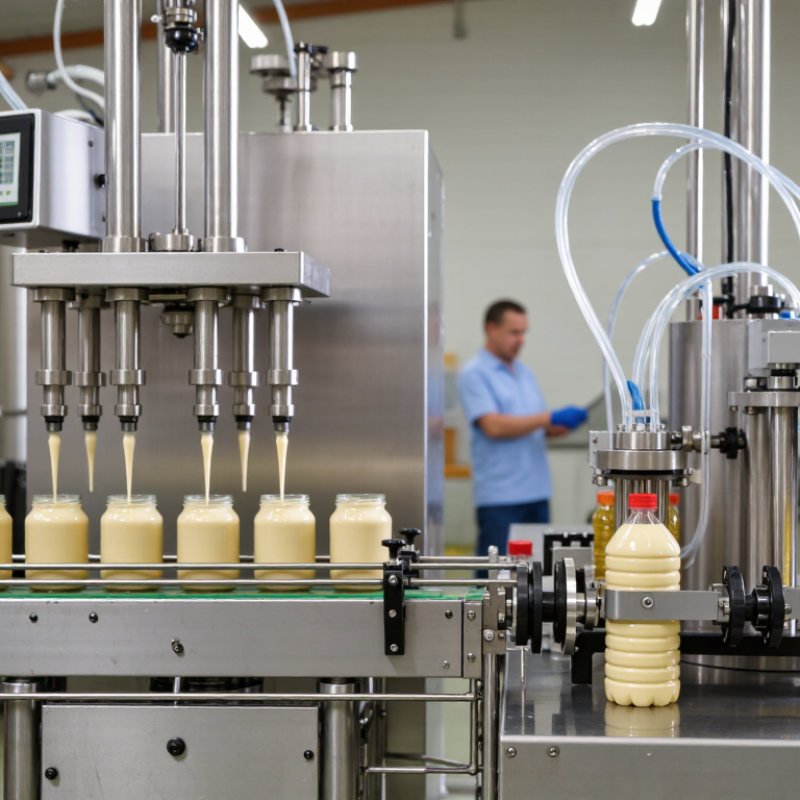
How to Choose Piston vs Gear Pump Filling Machines in 2026?

Piston vs Gear Pump Filling Machines: Core Principles and Design Differences

A piston pump uses a cylinder, piston, and valves to move a measured volume. Each stroke creates a clear dosing cycle. A gear pump uses two rotating gears to transfer liquid through controlled displacement. Its flow is more continuous, with less visible pulsation. These different operating principles affect accuracy, speed, pressure, and product handling.

In production trials, piston systems often perform well with thick creams, sauces, and gels. Their adjustable stroke supports repeatable volumes. Gear pumps suit thin or moderately viscous liquids that need steady flow. They can also support faster filling lines. However, gear teeth may create more shear than expected. Temperature changes can also alter viscosity and dosing results. Neither design works perfectly for every formula.

The filling machine should match the product, container, and cleaning process. A viscous product may need a wide inlet and gentle piston movement. A free-flowing liquid may benefit from gear-based continuous delivery. Contact parts should use suitable, traceable materials. Operators should check seals, clearances, and calibration records. Small trials matter. I would test filling accuracy at different temperatures and speeds before selecting equipment. A common mistake is choosing by speed alone. That decision can ignore cleaning time, product sensitivity, and maintenance access.

How Product Viscosity and Formulation Affect Pump Selection

How to Choose Piston vs Gear Pump Filling Machines in 2026?

Product viscosity often decides more than the machine specification sheet. Thin lotions and free-flowing liquids usually move smoothly through gear pumps. Their rotating gears provide steady flow and support continuous filling. Medium and thick products often suit piston pumps better. A piston delivers a measured volume with strong pressure control, even when the product resists movement.

Formulation details can change that choice. Creams may become thicker when they cool inside the supply line. Syrups can crystallize near narrow openings. Products containing small particles may need wider passages and gentler handling. A gear pump can create unwanted shear in some sensitive formulations. A piston pump may protect texture better, but its cycling action can increase foaming in aerated liquids. Small differences matter.

Real production trials remain essential. I would test the product at its lowest and highest working temperatures. Measure fill accuracy after several hours, not only during a short demonstration. Check whether the liquid slips backward through the pump or leaves residue inside valves. A viscosity chart helps, but it is not the whole truth. Formulas can behave unpredictably.

Keep the test records. Include viscosity, temperature, particle size, pressure, and cleaning time. These details give engineers reliable evidence for pump selection. An overlooked issue is often the transfer hose, not the pump. A narrow hose can make a suitable machine appear weak. In practice, the best choice is the one that preserves formulation quality while maintaining stable, repeatable fills.

How to Choose Piston vs Gear Pump Filling Machines in 2026?

How product viscosity and formulation affect pump selection

Piston pumps generally become more suitable as viscosity, solids content, and required dosing pressure increase. Gear pumps are often preferred for continuous, smooth-flow filling of low-to-medium-viscosity liquids. The scores are a practical engineering selection guide on a 1–5 scale, not a guaranteed performance rating; temperature, abrasiveness, shear sensitivity, and particle size must also be evaluated.

Comparing Filling Accuracy, Speed, and Container Compatibility

How to Choose Piston vs Gear Pump Filling Machines in 2026?

Piston and gear pump filling machines solve different production problems. Piston systems usually deliver strong volumetric accuracy for creams, sauces, gels, and other thick products. Their measured stroke supports consistent dosing, even when viscosity changes slightly. Gear pumps provide continuous flow and suit many oils, syrups, and fluid products. They can support faster filling with fewer pauses between containers. However, speed alone does not guarantee better output. A fast machine may create splashing, foaming, or uneven fill levels.

Container compatibility deserves equal attention. Piston fillers often handle wide bottles, jars, and larger dose volumes effectively. Gear pumps can work well with narrow containers when the nozzle and flow rate are correctly matched. Product sensitivity also matters. Some gear pumps may generate heat or shear during extended operation. That can affect delicate formulas. In real production trials, I have seen small changes in nozzle height alter accuracy noticeably. This is easy to underestimate. Test the actual product, container shape, closure, and target fill weight before selecting equipment.

Tips: Compare ten consecutive fills, not one successful sample. Record fill-weight variation, line speed, cleanup time, and product temperature. Check the smallest and largest container sizes. Ask operators to review changeover steps. Their feedback often reveals practical delays that specifications overlook. Leave room for adjustment; laboratory results rarely match a busy production floor perfectly.

How to Choose Piston vs Gear Pump Filling Machines in 2026? - Comparing Filling Accuracy, Speed, and Container Compatibility

Evaluation Dimension Piston Pump Filling Machine Gear Pump Filling Machine
Typical filling accuracy Approximately ±0.5% to ±1.0% of the target fill, when the product and machine are properly calibrated. Approximately ±0.5% to ±1.5% of the target fill; accuracy depends strongly on viscosity, temperature, and pump wear.
Typical production speed Commonly about 10–60 containers per minute, depending on fill volume, number of heads, and product flow characteristics. Commonly about 30–150 containers per minute for low- to medium-viscosity products, subject to pump size and container volume.
Best viscosity range Suitable for low-, medium-, and high-viscosity products, including creams, pastes, gels, sauces, and heavy liquids. Best for low- to medium-viscosity liquids; larger gear pumps can handle viscous products but may require slower speeds and stronger drive systems.
Container size flexibility Typically supports approximately 5 mL to 20 L, depending on cylinder size, filling head design, and machine configuration. Typically supports approximately 1 mL to 5 L; very small fills can be highly repeatable when the pump and control system are correctly sized.
Handling of particulates Can handle some soft particulates or suspended solids when equipped with suitable valves and a sufficiently large product path. Generally unsuitable for large or hard particulates because particles can cause wear, jamming, or damage between the gears.
Foaming and shear impact Usually provides relatively gentle product handling and can reduce foaming with appropriate suction and filling settings. Continuous gear rotation may introduce more shear and can increase foaming in some sensitive or air-entraining products.
Flow consistency Highly repeatable for each piston stroke; performance may vary if air enters the product or if the product changes significantly with temperature. Provides smooth, continuous flow and good repeatability when product viscosity remains stable.
Product temperature sensitivity Moderate sensitivity; fill accuracy can change when viscosity varies substantially between production batches. Higher sensitivity for products whose viscosity changes with temperature because pump output is closely linked to flow resistance.
Changeover and cleaning Often easy to clean when the piston, cylinder, and valves are designed for tool-free removal; more components may require inspection. Can have a compact product path, but gear clearances must be thoroughly cleaned to prevent cross-contamination and product buildup.
Maintenance requirements Routine inspection of seals, piston surfaces, valves, and pneumatic or servo components is required. Requires monitoring of gear wear, shaft seals, bearings, and clearances, especially with abrasive or poorly filtered products.
Recommended applications Creams, lotions, gels, sauces, pastes, syrups, detergents, and products requiring broad container or viscosity flexibility. Oils, solvents, liquid chemicals, inks, fragrances, and other clean liquids requiring fast, continuous metered flow.
Best choice when... The product is thick, contains limited soft particulates, or the line must accommodate multiple fill volumes and container formats. The product is clean and free-flowing, high throughput is important, and stable viscosity enables continuous metering.

Note: The figures shown are typical engineering ranges rather than guaranteed specifications. Actual performance depends on product viscosity, temperature, fill volume, container geometry, pump size, number of filling heads, control system, and machine calibration.

Evaluating Cleaning, Maintenance, and Operating Costs in 2026

How to Choose Piston vs Gear Pump Filling Machines in 2026?

Cleaning and maintenance can change the real cost of a filling machine. Piston fillers usually expose their valves, seals, and product-contact parts during teardown. This can simplify inspection after thick sauces or creams. However, more moving parts may increase replacement work. Gear pumps offer steady flow and compact construction. Their close clearances can trap sticky or particulate products, making cleaning more demanding. Product viscosity, temperature, and sanitation procedures matter more than pump type alone.

The U.S. Department of Energy reports that motor-driven systems use about 70% of industrial electricity. Therefore, gear pump efficiency deserves measurement under actual production loads, not brochure conditions. PMMI’s recent packaging industry research also identifies skilled labor shortages as a continuing operational challenge. A machine requiring specialist repairs may create expensive downtime. Deloitte’s 2024 Smart Manufacturing and Operations Survey found that 92% of manufacturers view smart manufacturing as important for competitiveness. Sensors can track fill pressure, motor current, and seal performance. Still, data does not replace a dirty, practical maintenance check.

Tips: Request a cleaning trial with your real product. Time the teardown. Record water, detergent, labor, and restart losses. Compare annual seal and valve costs. I would not choose the cheapest quote too quickly. An apparently simple gear pump may need longer cleaning. A piston machine may consume more spare parts. Your production records should decide.

Choosing the Right Filling Machine for Your Production Requirements

Choosing between piston and gear pump filling machines begins with your production requirements, not the machine’s headline speed. A piston filler suits viscous products, such as creams, sauces, and gels, because its measured stroke handles thicker materials consistently. A gear pump filler offers smoother continuous flow for oils, syrups, and low-to-medium viscosity liquids. Product temperature, foaming, particle size, container volume, and cleaning time also matter. The wrong pump can create dripping, air pockets, or unacceptable weight variation.

Industry data supports a practical approach. Grand View Research estimates the global filling machines market will expand at roughly 4% annually through 2030, driven by automation and flexible production. PMMI’s 2024 State of the Industry report also identifies labor shortages and efficiency demands as major equipment investment pressures. However, faster is not always better. A gear pump may reduce pulsation, yet it can struggle with abrasive particles or highly viscous products. A piston system may deliver stronger dose control, but its intermittent motion can limit output at higher speeds. Test your actual product at its real temperature. Small details matter.

Measure target fill accuracy, hourly demand, changeover frequency, cleaning procedures, and available floor space before requesting quotations. Ask suppliers for recorded trial results, not only catalog figures. I would also calculate total cost over five years, including seals, downtime, energy, and operator training. The first choice may still be imperfect. Production conditions change. Build in adjustment capacity.

FAQS

How does a piston pump measure liquid?

A piston moves inside a cylinder and creates a measured dosing cycle. Each stroke delivers a defined volume. Stroke length can be adjusted. Small errors may still appear.

How does a gear pump move liquid?

Two rotating gears transfer liquid through controlled displacement. The flow is steady and continuous. Visible pulsation is usually lower. Gear movement can create shear.

Which pump suits thick creams, sauces, and gels?

A piston pump often handles thick products more effectively. It provides strong pressure and repeatable dosing. A wide inlet may help. Temperature still matters.

Which pump works well with thin liquids?

A gear pump often suits thin or moderately viscous liquids. It supports steady flow and faster filling lines. The liquid should move freely through the passages. Do not choose speed alone.

Can product temperature change filling accuracy?

Yes. Cooling can thicken creams inside supply lines. Warming may reduce viscosity and change the delivered volume. Test the lowest and highest working temperatures. Temperature is easy to overlook.

How do particles and sensitive formulas affect pump selection?

Products with particles may need wider passages and gentler movement. A gear pump may damage texture through excessive shear. A piston pump may protect texture better. Aerated liquids can foam during cycling.

What should production trials measure?

Test fill accuracy at different temperatures and speeds. Measure results after several operating hours. Record viscosity, pressure, particle size, and cleaning time. A short demonstration is not enough.

Can the transfer hose affect pump performance?

Yes. A narrow hose can restrict flow and make a suitable pump seem weak. Check the inlet, hose, valves, and outlet together. Residue may remain inside valves. The pump is not always the problem.

What maintenance details deserve attention?

Operators should inspect seals, clearances, and calibration records. Cleaning access also matters. Traceable contact materials support reliable operation. Maintenance assumptions can fail.

What is the most practical selection rule?

Choose the pump that protects product quality and maintains repeatable fills. Compare accuracy, speed, cleaning, sensitivity, and maintenance access. The fastest machine may be the wrong machine. More testing is usually wiser.

Conclusion

Choosing the right filling technology in 2026 requires a clear understanding of how piston and gear pump systems work. Piston pumps use measured chamber volumes to deliver consistent fills, making them suitable for thicker products and applications requiring precise portion control. Gear pumps provide continuous, smooth flow and can be effective for low- to medium-viscosity liquids, especially when steady output and flexible speed control are important. Product viscosity, temperature sensitivity, particle content, and formulation stability should guide the initial selection.

How to choose between piston and gear pump filling machines also depends on production priorities. Piston systems may offer excellent accuracy across different container sizes, while gear pumps can support efficient high-speed operation and compact equipment designs. Consider cleaning procedures, changeover time, component wear, energy use, and long-term maintenance costs before making a decision. The best machine should match your product characteristics, target fill accuracy, container range, production volume, sanitation requirements, and available budget.

Liam

Liam

Liam is a dedicated marketing professional with a profound expertise in the industry, where he excels at highlighting the unique advantages of our core products. With a keen understanding of market trends and consumer needs, Liam frequently updates our company’s professional blog, providing......