When businesses contemplate choosing between automatic and semi-automatic filling machines, understanding their differences is crucial. Expert in packaging machinery, Dr. Sarah Thompson, emphasizes, "The right filling machine can significantly enhance production efficiency and meet unique needs." This insight captures the essence of the decision-making process.
Automatic filling machines are designed for high-volume production. They operate independently, minimizing human intervention. This allows for consistent output and precision. Conversely, semi-automatic machines require manual setup and oversight. While they offer flexibility, they may not match the speed of their automatic counterparts.
What is the difference between automatic and semi-automatic filling machines? It lies in automation levels and operational control. Choosing the right type is not always straightforward. It often depends on the specific needs of the production line, product type, and budget constraints. Balancing these factors requires careful consideration for optimal results.
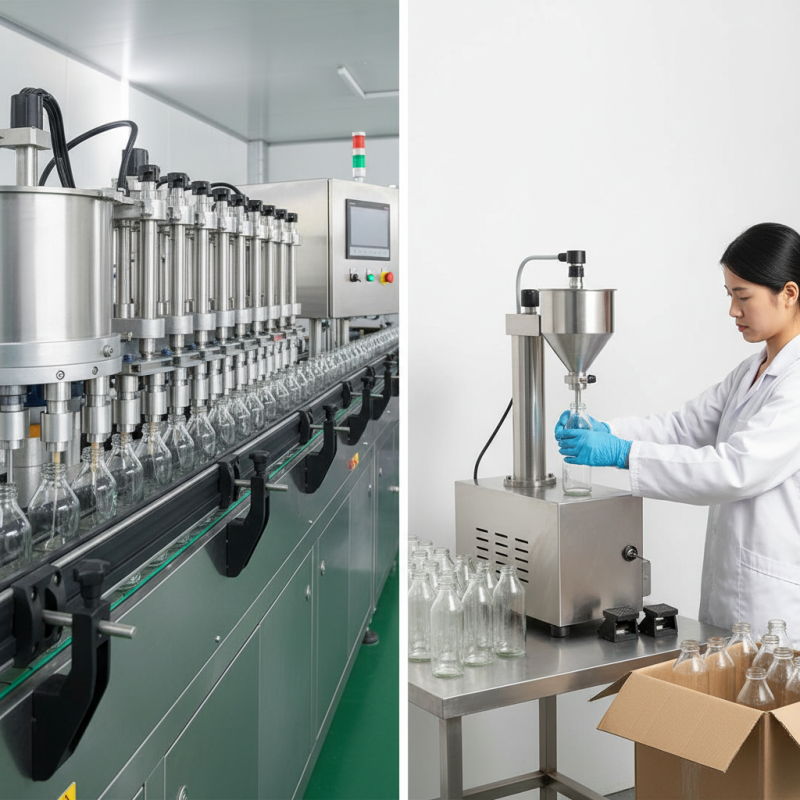
Choosing the right filling machine is critical for your business. Several factors influence this decision. Understand your production volume first. Automatic machines excel in high-output environments. They operate continuously and require minimal intervention. However, they come with higher initial costs. Semi-automatic machines, in contrast, are more versatile. They suit small to medium volumes well. Their affordability and lower operational costs appeal to many businesses.
Next, consider product characteristics. The viscosity of your product plays a role. For thick liquids, specific machines handle them better. Also, packaging type matters. Certain machines cater to bottles, pouches, or jars. Assessing your packaging needs can prevent costly mistakes. Keep in mind that staff training is essential for both types of machines. Investing in employee skill development enhances efficiency.
Maintenance requirements should not be overlooked. Automatic machines might demand specialized skills for repairs. Semi-automatic options can be simpler to maintain. Evaluate your team's capabilities in managing these machines effectively. Finally, think about the scalability of your operation. You might need upgrades as your business grows. Striking a balance between cost and efficiency requires careful planning. Reflect on your long-term goals as you make this choice.
| Factor | Automatic Filling Machines | Semi Automatic Filling Machines |
|---|---|---|
| Production Volume | High volume, suitable for large-scale production | Lower volume, ideal for smaller batches |
| Operational Complexity | More complex, requires trained operators | Less complex, easier to operate |
| Initial Investment Cost | Higher initial investment | Lower initial investment |
| Maintenance | Requires periodic and specialized maintenance | Easier maintenance, can often be performed by in-house staff |
| Flexibility | Less flexibility with product changeovers | More flexibility for different product types and sizes |
| Labor Requirements | Reduced labor needs once set up | Higher labor involvement during operation |
| Speed | High speed, suitable for fast-paced environments | Moderate speed, less suitable for very high-speed needs |
: Automatic machines operate independently, while semi-automatic machines involve human control during the filling process.
Automatic filling machines can achieve speeds up to 120 bottles per minute in large-scale operations.
Semi-automatic machines usually fill 30-60 bottles per minute, making them slower than their automatic counterparts.
They provide high output, consistent quality, and reduced labor costs over time.
They can lead to inconsistencies due to human error and require well-trained operators for optimal results.
Companies should analyze production needs, considering speed, flexibility, and potential growth.
Companies may find long-term savings and efficiency can justify the investment, especially for high-speed needs.
Yes, they allow for adjustments, making them suitable for businesses with varying product types.
Proper training and machine settings can enhance speed and accuracy, especially for semi-automatic machines.
Companies need to consider current needs, future scalability, efficiency, and cost balance.
When choosing between automatic and semi-automatic filling machines, several critical factors come into play. Understanding what is the difference between automatic and semi-automatic filling machines is essential for optimizing production. Automatic machines offer higher production speeds and require minimal operator intervention, making them ideal for high-volume operations. In contrast, semi-automatic machines provide greater flexibility and control, often at a lower initial cost, making them suitable for smaller businesses or those with fluctuating production needs.
Cost efficiency is another essential consideration; while automatic machines may have a higher upfront cost, they can lead to better ROI through increased output and reduced labor costs. Quality control is vital in both systems, ensuring precision in filling processes. By carefully evaluating production speed, cost implications, and quality standards, businesses can make informed decisions that align with their operational goals.

 Yongli Machine